神父马克西姆:修道生活中的诗篇祈祷——西蒙诺佩特拉的艾米利安长老注释
目录
- 按:这是神父马克西姆(Fr. Maximos Constas)于2021年圣约翰施洗者东正教团契学习周末(Orthodox Fellowship of St John the Baptist 2021 Study Weekend)上的公开讲座,讲题为「修道生活中的诗篇祈祷——西蒙诺佩特拉的艾米利安长老注释」。本文为中英双语对照文本,由阿甲整理『若整理和翻译有任何问题,欢迎指正』。
若要引用本文,ephremyuan,《神父马克西姆:修道生活中的诗篇祈祷——西蒙诺佩特拉的艾米利安长老注释》(伦敦:光从东方来,2021年06月09日),本网页网址,引用日期。也请参考版权申明
油管订阅,以及📁网盘
神父马克西姆:修道生活中的诗篇祈祷——西蒙诺佩特拉的艾米利安长老注释
joining us for the first time during this study weekend on the Psalms Prayer Book of the Church. This study weekend is organised by the parish of St John the Evangelist in Cambridge, but supported by the Orthodox Fellowship of St John the Baptist, which I represent, I’m the chair. I’m really happy to be welcoming you all to the final lecture session of the study weekend, but it’s not the end of the study weekend. We will also celebrate vespers together at five o’clock UK time and the divine liturgy tomorrow as well at 11 o’clock UK time, and thanks to the parishes in Cambridge for helping us ensure that we could join with them in worship even though we can’t be together in person. I think Father started the recording, that’s great, so I will move straight on and introduce our speaker for this session, Father Maximus Constas. Father Maximus is Interim Dean and Professor of Patristics and Orthodox Spirituality at Holy Cross Greek Orthodox School of Theology in Brookline, Massachusetts in the US. He holds a PhD in Patristics and Historical Theology from the Catholic University of America which is in Washington DC.
欢迎首次参加这次关于教会《诗篇祈祷书》的学习周末。这次学习周末由剑桥的圣约翰福音传道者堂区组织,并由我代表并担任主席的施洗约翰东正教团契提供支持。我非常高兴地欢迎大家参加本次学习周末的最后一次讲座,但这并不是学习周末的结束。我们还将按英国时间下午五点一起庆祝晚祷,明天英国时间上午十一点也会举行圣礼仪,感谢剑桥的各个堂区帮助我们确保即使不能亲自聚在一起,也能与他们一起崇拜。我想神父已经开始录音了,太好了,所以我将直接进入正题,介绍本次讲座的讲员,马克西姆·康斯塔斯神父。马克西姆神父是美国马萨诸塞州布鲁克莱恩的圣十字架希腊东正教神学院的临时院长,以及教父学和东正教灵修教授。他拥有位于华盛顿特区的美国天主教大学的教父学和历史神学博士学位。
For many years he was a Professor of Theology at Harvard Divinity School, after which he became a monk at the monastery of Simón Opetra on Mount Athos. He recently published a work, St Maximus the Confessor on difficulties in sacred scripture, the responses to Thalassios, which follows his edition and translation of St Maximus the Confessor on difficulties in the church fathers, the Ambigua to Thomas and the Ambigua to John. He’s the author of The Art of Seeing, Paradox and Perception in Orthodox Iconography, also Proclus of Constantinople and the Cult of the Virgin in Late Antiquity, as well as numerous scholarly articles and translations, including four volumes of the writings of the contemporary Athenite elder Emelianos of Simonopetra, The Church at Prayer, The Way of the Spirit, Psalms and the Life of Faith, and The Mystical Marriage. His most recent publications are Mother of the Light, Prayers to the Theotokos, and St John Chrysostom and the Jesus Prayer. His work focuses on the patristic and Byzantine theological tradition, the patristic interpretation of scripture, the philokalia and Orthodox spirituality and the theological study of Byzantine art, icons and iconography. We’re so happy that Father Maximus can be with us on Zoom so that he can join us all the way from the US. And he will be talking to us with a theme of praying the Psalms in monastic life and the commentaries of Elder Emilianos of Simonopetra. Father Maximus, thank you for joining us and I pass over to you.
多年来,他一直是哈佛神学院的神学教授,之后他在阿索斯山的西蒙诺佩特拉修道院成为一名修士。他最近出版了一部著作《认信者圣马克西姆论圣经中的难题:致撒拉修的回应》,这是继他编辑和翻译的《认信者圣马克西姆论教父中的难题:致托马斯的难题与致约翰的难题》之后的又一力作。他是《看见的艺术:东正教圣像画中的悖论与感知》的作者,也是《古代晚期的君士坦丁堡的普罗克洛斯与圣母敬礼》的作者,此外还有大量学术文章和译作,包括当代雅典的西蒙诺佩特拉的艾米利安长老著作的四卷本:《祈祷的教会》、《圣灵之路》、《诗篇与信仰生活》以及《奥秘的婚姻》。他最近的出版物是《光之母:向诞神女的祈祷》以及《金口约翰与耶稣祷文》。他的工作重点是教父和拜占庭神学传统、教父对圣经的诠释、爱神集与东正教灵修,以及拜占庭艺术、圣像和圣像学的神学研究。我们非常高兴马克西姆神父能通过Zoom与我们同在,这样他就能从美国远道而来加入我们。他将与我们探讨的主题是修道生活中的诗篇祈祷以及西蒙诺佩特拉的艾米利安长老的注释。马克西姆神父,感谢您的加入,现在把时间交给您。
Thank you. You had asked me earlier to begin with a prayer. Would you like me to do that? In the name of the Father and the Son and the Holy Spirit. O Heavenly King, Comforter, Spirit of Truth, who art everywhere present and fillest all things, Treasury of good things and giver of life, come and abide in us and cleanse us from every stain and save our souls, O good one. Thank you, Margaret, for that very kind introduction and thanks also to the organizers of this event who reached out to me and invited me to participate. I was happy to do so. It was an opportunity to talk about a beloved topic but also about a beloved figure, the Abbot Elder Mirianos, who I will return to in a moment.
谢谢。您早些时候要求我以祈祷开始。您希望我这样做吗?因圣父、圣子、圣灵之名。 哦,天上的君王,保惠师,真理之灵,无所不在且充满万有者,良善之宝库与赐生命者,求你降临并住在我们内,洗净我们的一切污点,拯救我们的灵魂,哦,良善者。 谢谢你,玛格丽特,感谢你非常友善的介绍,也感谢这次活动的组织者联系我并邀请我参加。我很乐意这样做。这是一个谈论心爱话题的机会,也是一个谈论心爱人物的机会,即院长艾米利安长老,我稍后会再谈到他。
Before I begin, let me just give you a general idea of what I hope to cover. Over the next few minutes, I begin with some general words, general remarks about psalms in monastic life. It’s a very large topic. I’ll just touch on a few things. After that, I’ll introduce Elder Emiliano of Simanopatra, since some of you might not be familiar with him. And then after saying a few words about his psalm commentaries, I’ll focus on a theme within those commentaries, namely illness and suffering, which is a prominent feature of those commentaries on the Psalms, but they’re also a prominent feature of his thought more generally. So the title of my talk is Praying the Psalms in Monastic Life, Elder Emiliano Subsemanopetra and the Psalms.
在我开始之前,让我先大致介绍一下我希望涵盖的内容。在接下来的几分钟里,我将先讲一些关于修道生活中诗篇的一般性话语和一般性评论。这是一个非常大的话题。我只触及其中几点。之后,我将介绍西马诺帕特拉的艾米利安长老,因为你们中有些人可能对他不太熟悉。然后,在简短地谈谈他的诗篇注释之后,我将重点关注这些注释中的一个主题,即疾病与苦难,这不仅是这些诗篇注释的显著特征,也是他更广泛思想的显著特征。因此,我演讲的题目是《修道生活中的诗篇祈祷:西马诺帕特拉的艾米利安长老与诗篇》。
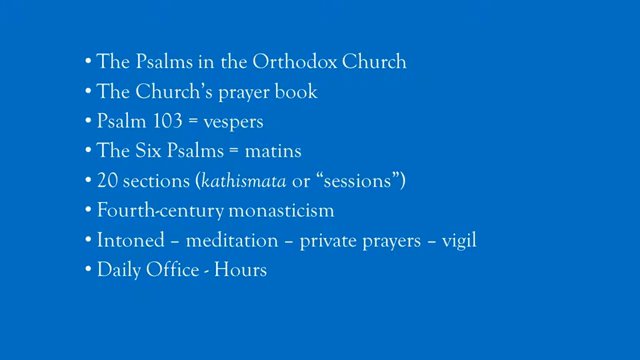
The Psalms hold a special place in the devotional life of the Orthodox Church. There is no divine liturgy, no daily office, no occasional prayer service that does not include psalms or passages from the psalms. As the theme of this study weekend indicates, the Psalter has always been the church’s prayer book, which is why the psalms are not read in church as lessons or lections in quite the same way that the gospels and the epistles are, but rather they are read and heard more like prayers. The use of psalms in the Orthodox Church takes two basic forms. First, all church services include one or more psalms among their fixed elements, such as Psalm 103, which is read at the beginning of Vespers, or the six psalms that are read at the beginning of Matins, to mention just two examples. Second, and in monastic practice, the Psalter is divided into 20 sections, which are read section by section at Matins and Vespers so that the entire Psalter is read in its entirety once a week, every week of the year. The exception to this rule is Holy Week when the Psalter is read twice in its entirety and these sections or divisions are known as kafizmata, which means sessions since it is permissible to sit during the reading of the Psalms. It’s also noteworthy that particular psalms or psalm verses are read individually or in groups during the great feasts of the Lord and the Mother of God. And these selected psalms and verses sort of expand and build on the theme and the theological meaning of the feast being celebrated. And they’re very closely intertwined with those liturgical events. So it would not be an exaggeration to say that the psalms constitute an indispensable component of the church’s worship, providing a kind of constant undertow to all the services, and this is especially true in monastic usage.
诗篇在东正教的灵修生活中占有特殊地位。没有一场圣礼仪、日课或特别祈祷仪式不包括诗篇或诗篇的段落。正如本次学习周末的主题所表明的那样,诗篇集一直是教会的祈祷书,这就是为什么诗篇在教会中不像福音书和书信那样作为经课或诵读来阅读,而是更像祈祷一样被诵读和聆听。诗篇在东正教中的使用有两种基本形式。首先,所有教会礼仪的固定元素中都包含一首或多首诗篇,例如在晚祷开始时诵读的诗篇103,或在晨祷开始时诵读的六首诗篇,仅举两例。其次,在修道实践中,诗篇集被分为20个部分,在晨祷和晚祷时逐段诵读,以便在每周、一年中的每一周都能完整诵读整卷诗篇集。这条规则的例外是圣周,届时诗篇集会被完整诵读两次,这些部分或划分被称为“kafizmata”,意思是“场次”,因为在诵读诗篇时允许坐下。同样值得注意的是,在主和上帝之母的伟大节日里,会单独或成组地诵读特定的诗篇或诗篇经文。这些选定的诗篇和经文在某种程度上扩展并建立于所庆祝节日的主题和神学意义之上。它们与那些礼仪事件紧密交织在一起。因此,毫不夸张地说,诗篇构成了教会崇拜不可或缺的组成部分,为所有礼仪提供了一种持续的暗流,在修道用法中尤其如此。
Now the use of the psalter has been central to early monastic life since the beginning of the fourth century, when an unprecedented wave of enthusiasm for the singing and intoning of the Psalms swept from the Greek East to the Latin West. Early monks, such as those in Egypt and Palestine, spent much of their time intoning the Psalms in a kind of low monotone. The aim was not choral singing or a corporate act of liturgical praise, but rather an aid to meditation. And there are many stories that describe the monks of the Egyptian desert keeping vigil at night by reading the Psalter, or interrupting their work during the day at intervals to recite psalms. Eventually a daily office evolved which incorporated the psalms into formal worship, and these are known for example as the Hours, which continue to be read in monasteries and in some cases in some parishes.
自四世纪初以来,诗篇集的使用一直是早期修道生活的核心,当时一股前所未有的对唱诵诗篇的热情从希腊东方席卷到拉丁西方。早期的修士,例如在埃及和巴勒斯坦的修士,花费大量时间用一种低沉的单调语调吟诵诗篇。 其目的不是合唱或集体的礼仪赞美行动,而是作为默念的辅助。有许多故事描述了埃及沙漠的修士在夜间通过阅读诗篇集来守夜,或者在白天不时中断工作来背诵诗篇。 最终发展出了一种日课,将诗篇纳入正式的崇拜中,例如被称为时辰祈祷,这些祈祷至今仍在修院中诵读,在某些情况下也在一些堂区中诵读。
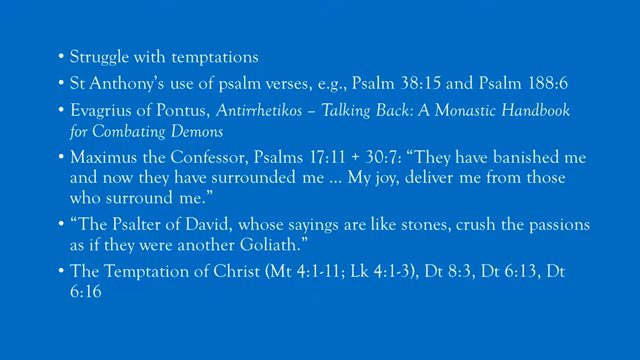
In the monastic tradition, the Psalms also played and continue to play an important role in the spiritual life, especially in the struggle with thoughts and temptations. This is already clear in the life of Anthony, where the saint cites Psalm 3815 as a biblical warrant for ignoring the taunts of the demons. I wait for you, O Lord. You will answer, O Lord my God. The idea is that the saint himself does not respond to the demonic thoughts or temptations. He waits for the Lord to respond to them. Saint Anthony also invokes Psalm 188.6. The Lord is with me. I will not be afraid. What can mere mortals do to me? In fact, in the life of Anthony, the saint cites psalm verses only when he is battling demonic temptations and teaching other monks about this kind of warfare, which points to the specific role that the Psalms played in early monastic life and in the struggle with temptation. Evagrius of Pontus, a younger contemporary of Saint Anthony, compiled a book on this subject called the Andiritikos, which is translated as talking back, and the subtitle that the modern translator gave it is a monastic handbook for combating demons. This is a short work listing various thoughts and how to respond to them by reciting the appropriate scriptural passage. Many of these passages are taken from the Psalms, but others are from the New Testament. So for example, Evagrius says, and I quote, in response to the thoughts that make us grieve over the failings of the brethren, let us say, bear one another’s burdens and in this way you fulfill the law of Christ, which is Galatians 6.2. This practice continued into the Byzantine period, and a writer like Maximus the Confessor tells us that, quote, when the demons have banished chastity from your mind and surround you with thoughts of fornication, turn to the Lord and say, quote, they have banished me and now they have surrounded me. My joy, deliver me from those who surround me, which is a combination of Psalms 1711 and 37. A poem from the later Byzantine period, which is inscribed on the first page of a Psalter, likewise sums up this practice. And you have the quotation on the screen, the Psalter of David, whose sayings are like stones, crush the passions as if they were another Goliath. So the practice of rebutting negative thoughts with biblical verses was inspired by Christ himself, who, when tempted by the devil, rebutted the temptations of the devil by citing passages from Deuteronomy. And the reason that they’re from Deuteronomy is because the Lord is in the wilderness and he’s recapitulating the time of the Israelites in the wilderness as described in Deuteronomy. But the practice of rebutting temptations or thoughts with scriptural passages or scriptural verses is something that the early monks saw authorized in the life of Christ himself. Let’s now introduce the Athonite abbot, Elder Aemilianos, whose commentaries on the Psalms we will look at in some detail.
[Translation Error: In the monastic tradition, the Psalms also played and continue to play an important role in the spiritual life, especially in the struggle with thoughts and temptations. This is already clear in the life of Anthony, where the saint cites Psalm 3815 as a biblical warrant for ignoring the taunts of the demons. I wait for you, O Lord. You will answer, O Lord my God. The idea is that the saint himself does not respond to the demonic thoughts or temptations. He waits for the Lord to respond to them. Saint Anthony also invokes Psalm 188.6. The Lord is with me. I will not be afraid. What can mere mortals do to me? In fact, in the life of Anthony, the saint cites psalm verses only when he is battling demonic temptations and teaching other monks about this kind of warfare, which points to the specific role that the Psalms played in early monastic life and in the struggle with temptation. Evagrius of Pontus, a younger contemporary of Saint Anthony, compiled a book on this subject called the Andiritikos, which is translated as talking back, and the subtitle that the modern translator gave it is a monastic handbook for combating demons. This is a short work listing various thoughts and how to respond to them by reciting the appropriate scriptural passage. Many of these passages are taken from the Psalms, but others are from the New Testament. So for example, Evagrius says, and I quote, in response to the thoughts that make us grieve over the failings of the brethren, let us say, bear one another’s burdens and in this way you fulfill the law of Christ, which is Galatians 6.2. This practice continued into the Byzantine period, and a writer like Maximus the Confessor tells us that, quote, when the demons have banished chastity from your mind and surround you with thoughts of fornication, turn to the Lord and say, quote, they have banished me and now they have surrounded me. My joy, deliver me from those who surround me, which is a combination of Psalms 1711 and 37. A poem from the later Byzantine period, which is inscribed on the first page of a Psalter, likewise sums up this practice. And you have the quotation on the screen, the Psalter of David, whose sayings are like stones, crush the passions as if they were another Goliath. So the practice of rebutting negative thoughts with biblical verses was inspired by Christ himself, who, when tempted by the devil, rebutted the temptations of the devil by citing passages from Deuteronomy. And the reason that they’re from Deuteronomy is because the Lord is in the wilderness and he’s recapitulating the time of the Israelites in the wilderness as described in Deuteronomy. But the practice of rebutting temptations or thoughts with scriptural passages or scriptural verses is something that the early monks saw authorized in the life of Christ himself. Let’s now introduce the Athonite abbot, Elder Aemilianos, whose commentaries on the Psalms we will look at in some detail.]
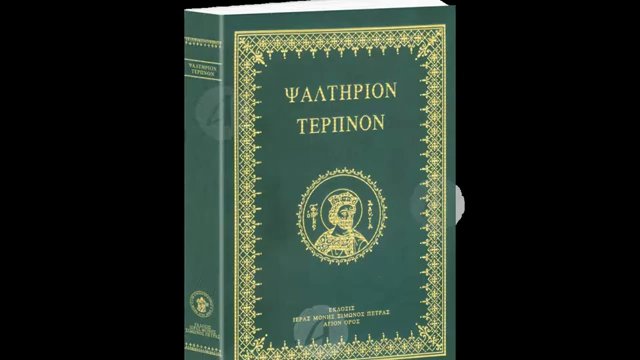
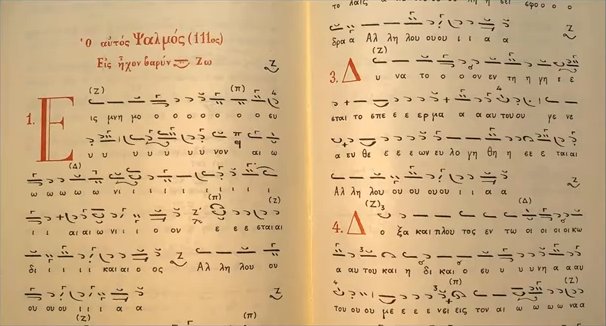
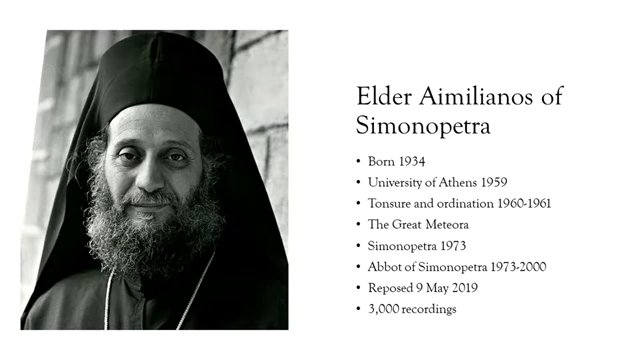
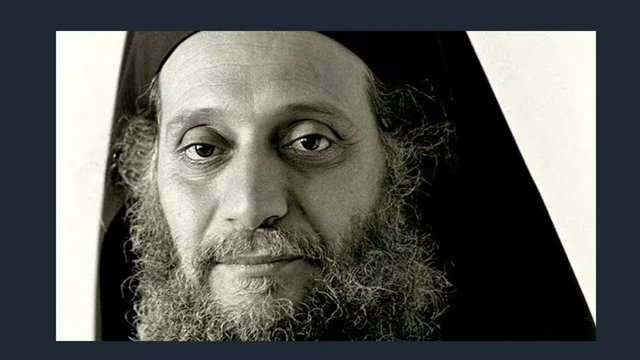
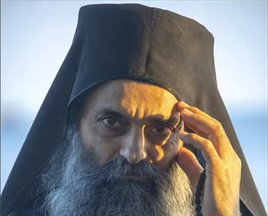
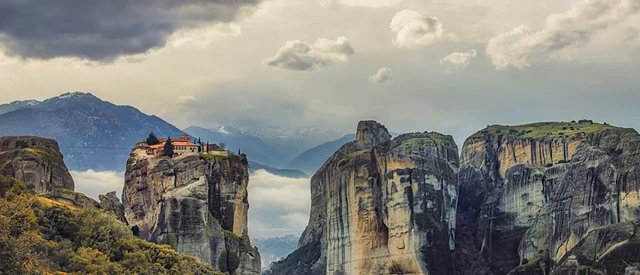
Elder Aemilianos was born in a suburb of Athens in 1934. He graduated with a theological degree from the University of Athens in 1959. He became a monk and was ordained to the diaconate and priesthood over the years 1960 and 1961 and lived at monasteries in central Greece including the great Meteora. He and his brother relocated to the monastery of Simonopetra in 1973, and I just want to share with you two pictures of the monastery of Simonopetra in case you haven’t seen it or in case you’re not familiar with it. Here’s one, and I have another one here taken on the other side from down in the garden. The elder served as abbot at Simonopetra from 1973 until the year 2000. He was a prolific speaker, and the monastery archive contains an astonishing 3,000 recordings of his talks given over a period of about 30 years. Many of these talks were given to monastic audiences, but a large number were given at parishes in Greece and Cyprus. And these recordings are now the basis for the growing number of his published works. And the elder reposed in the Lord on the 9th of May in 2019. Elder Aemilianos was a learned monastic leader, and he encouraged spiritual reading and spiritual study with particular emphasis on sacred scripture. There were no monks at his monastery who had not read the whole of the Bible many, many times over, and the general rule for reading scripture that he stipulated was that for each chapter read from the New Testament, the monk had to read twice that number from the Old. So if you read two chapters from the New Testament, you read four from the Old Testament. Now, the reason for this was obviously partly practical, because the Old Testament is a much larger book, and it’s longer to get through. But it was also, and I think more importantly, because the elder had a special devotion to the Old Testament, and in particular to the Book of Psalms. This devotion can be seen, for example, in the elder’s revival of the Psalter as a collection of psalms to be sung. So at this point in the monasteries and in the Greek Orthodox Church in general, psalms were no longer being sung. They were simply read as appointed in the service. But under the elder’s influence, a lengthy work, this volume that you see in front of you, of nearly 700 pages containing original music settings for 51 of the 150 psalms in the Psalter. The psalms are arranged in numerical order, and this was a welcome development since, as I said, whereas the psalms continue to be read, it was not often that they were sung, and the collection has led to a revival of their use as chants. And those of you who are not familiar with what Byzantine notation looks like, here are a couple of pages from the book that I just showed you. I don’t know what sorts of customs or practices you follow in your parishes, but it’s entirely possible that some of you actually sing these in your church because they have been translated into English with different kinds of musical notation.
艾米利安长老于1934年出生在雅典的一个郊区。他于1959年毕业于雅典大学并获得神学学位。他在1960年和1961年间成为修士,并被按立为执事和神父,居住在希腊中部的修院,包括伟大的迈泰奥拉。他和他的兄弟于1973年搬到西莫诺佩特拉修道院,我只是想与你们分享两张西莫诺佩特拉修道院的照片,以防你们没有见过它或者对它不熟悉。这是一张,我这里还有另一张,是从下面花园的另一侧拍的。长老从1973年到2000年担任西莫诺佩特拉修道院的修院院长。他是一位多产的演讲者,修道院的档案中包含了他在大约30年间发表的令人惊叹的3000份演讲录音。这些演讲中有许多是针对修道听众的,但也有大量是在希腊和塞浦路斯的堂区发表的。这些录音现在是他日益增多的出版著作的基础。长老于2019年5月9日在主内安息。艾米利安长老是一位博学的修道领袖,他鼓励属灵阅读和属灵学习,特别强调圣经。他的修道院里没有修士没有把整本圣经读过许多许多遍,他规定的阅读圣经的一般规则是,每读新约的一章,修士就必须读旧约两倍数量的章节。所以如果你读新约两章,你就读旧约四章。现在,这样做的原因显然部分是出于实际考虑,因为旧约是一本大得多的书,读完需要更长的时间。但这也,而且我认为更重要的是,因为长老对旧约,特别是对诗篇,有着特别的敬礼。例如,这种敬礼可以从长老复兴诗篇集作为可唱诵的诗篇集中看出来。所以在此时,在修道院和整个希腊东正教中,诗篇不再被唱诵。它们只是在仪式中按规定被宣读。但在长老的影响下,一部篇幅很长的著作,也就是你们面前看到的这一卷,近700页,包含了诗篇集中150首诗篇中的51首的原创音乐配曲。诗篇按数字顺序排列,这是一个受欢迎的发展,因为正如我所说,虽然诗篇继续被宣读,但它们很少被唱诵,而这个集子促成了它们作为圣颂使用的复兴。你们中那些不熟悉拜占庭记谱法是什么样子的人,这里有几页我刚才给你们看的书。我不知道你们在堂区遵循什么样的习俗或做法,但你们中有些人完全有可能在教会中唱这些,因为它们已经被翻译成带有不同音乐记谱法的英文。
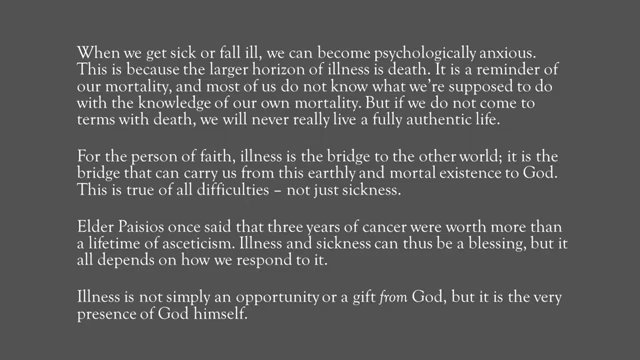
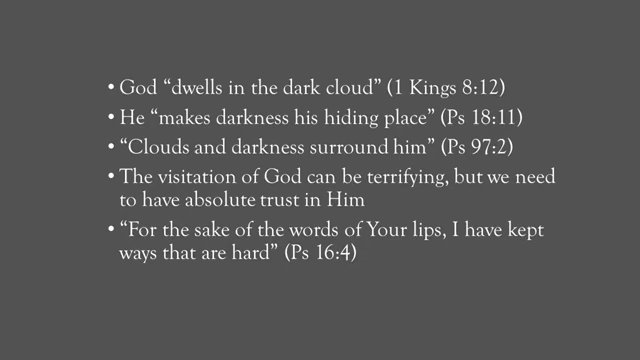
Now for the remainder of my talk, I would like to focus on the theme of sickness and suffering, about which the elder has a great deal to say in his commentaries on the Psalms. The elder understands illness to be a blessing, a gift from God given to us so that we may draw closer to God and be united to him. Illness is not something that happens by chance or randomly, but is a concrete expression of God’s providential care for us. It should be noted that for many years the elder bore the cross of severe illness which gives his words special weight and authority. I would now like to spend the rest of my time with you here, sharing with you some of the elder’s words on sickness and suffering, which are also relevant to any kind of trial or any kind of tribulation or difficulty that we might face. And what follows here are simply quotations from his commentaries and his writings that I’ll be sharing with you. When we get sick or fall ill, we become psychologically anxious. This is because the larger horizon of illness is death. It is a reminder of our mortality, and most of us do not know what we’re supposed to do with the knowledge of our own mortality. But if we do not come to terms with death, we will never really live a fully authentic life. For the person of faith, illness is the bridge to the other world. It is the bridge that can carry us from this earthly and mortal existence to God. This is true of all difficulties, not just of sickness. Elder Pius, who’s now Saint Pius, once said that three years of cancer were worth more than a lifetime of asceticism. Illness and sickness can thus be a blessing, but it all depends on how we respond to it. Illness is not simply an opportunity or a gift from God, but it is the very presence of God himself. Now, these are themes to which the elder returns in many of his talks, especially, as I’ve said, in his reflections on the Psalms, where he says that God comes to us in and through our difficulties in the very midst of our afflictions. And he reminds us that God dwells in the dark cloud, that God makes darkness his hiding place and clouds and darkness surround him. He says that this visitation of God can be terrifying, but we need to have absolute trust in God during those times of visitation.
现在,在我演讲的剩余部分,我想集中讨论疾病与苦难的主题,长老在他的《诗篇》注释中对这个主题有很多论述。 长老认为疾病是一种祝福,是上帝赐给我们的礼物,好让我们能更亲近上帝并与他合一。 疾病不是偶然或随机发生的事情,而是上帝对我们眷顾的具体体现。 应当指出,长老多年来背负着重病的十字架,这使得他的话语具有特殊的分量和权威。 现在,我想利用在这里与你们共度的剩余时间,与你们分享长老关于疾病与苦难的一些话语,这些话语也适用于我们可能面临的任何试炼、患难或困难。接下来我要与你们分享的,仅仅是引自他注释和著作的引文。 当我们生病或患病时,我们在心理上会变得焦虑。这是因为疾病的更大背景是死亡。它提醒我们终有一死,而我们大多数人不知道该如何面对自己终有一死这一事实。但如果我们不能与死亡和解,我们就永远无法过上真正完全真实的生活。对于有信仰的人来说,疾病是通往另一个世界的桥梁。它是能将我们从这尘世和必死的存在带向上帝的桥梁。所有的困难都是如此,不仅仅是疾病。 皮乌斯长老(现在是圣皮乌斯)曾说,三年的癌症比一生的苦修更有价值。因此,疾病可以是一种祝福,但这完全取决于我们如何回应它。 疾病不仅仅是一个机会或来自上帝的礼物,它就是上帝自己的同在。这些是长老在许多谈话中反复提及的主题, 正如我所说,特别是在他对《诗篇》的反思中,他说上帝在我们的困难中,在我们受苦的最深处临到我们。他提醒我们,上帝居住在黑云中,上帝以黑暗为他的藏身之处,密云和黑暗环绕他。他说,上帝的这种造访可能令人恐惧,但在那些造访的时刻,我们需要对上帝有绝对的信任。
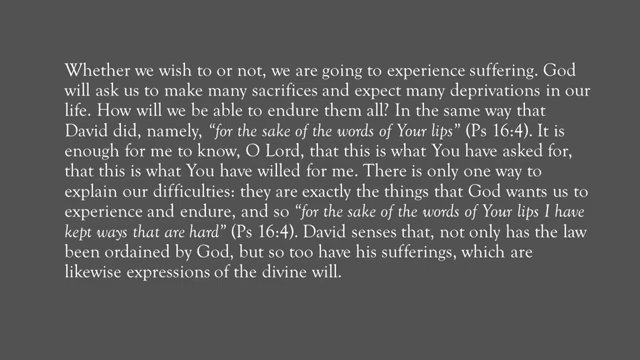
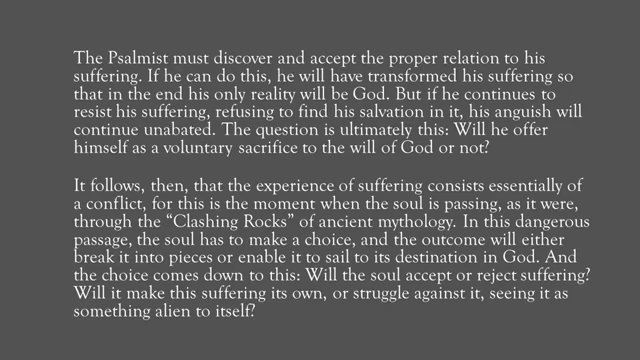
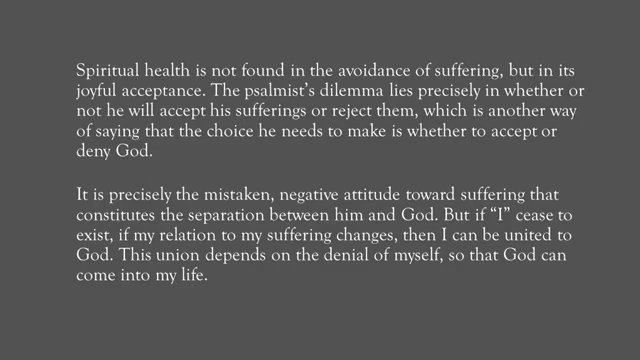
In a series of reflections on Psalm 16, 4, For the sake of the words of your lips, I have kept ways that are hard. The elder says, Whether we wish to or not, we are going to experience suffering. God will ask us to make many sacrifices and expect many deprivations in our life. How will we be able to endure them all? In the same way that David did, namely, for the sake of the words of your lips. It is enough for me to know, O Lord, that this is what you have asked for, that this is what you have willed for me. There is only one way to explain our difficulties. They are exactly the things that God wants us to experience and endure. And so, for the sake of the words of your lips, I have kept ways that are hard. David senses that not only has the law been ordained by God, but so too have his sufferings, which are likewise expressions of the divine will. And he goes on. The psalmist must discover and accept the proper relation to his suffering. If he can do this, he will have transformed his suffering so that in the end his only reality will be God. But if he continues to resist his suffering, refusing to find his salvation in it, his anguish will continue unabated. The question then is ultimately this. Will he offer himself as a voluntary sacrifice to the will of God or not? And these continue to be the words of the elder, just so we’re clear about that. It follows then that the experience of suffering consists essentially of a conflict, for this is the moment when the soul is passing, as it were, through the clashing rocks of ancient mythology. In this dangerous passage, the soul has to make a choice, and the outcome will either break it into pieces or enable it to sail to its destination in God. And the choice comes down to this. Will the soul accept or reject suffering? Will it make this suffering its own or struggle against it, seeing it as something alien to itself? Spiritual health is not found in the avoidance of suffering, but in its joyful acceptance. The psalmist’s dilemma lies precisely in whether or not he will accept his sufferings or reject them, which is another way of saying that the choice he needs to make is whether to accept or deny God. It is precisely the mistaken negative attitude towards suffering that constitutes the separation between him and God. But if I cease to exist, if my relation to my suffering changes, then I can be united to God. This union depends on the denial of myself so that God can come into my life. Now elsewhere the elder describes this conflict, this struggle with God, in terms inspired by Jacob’s struggle with the angel. And this in fact is one of his more beloved kinds of images or metaphors that he returns to often, as in this example here. Through sickness, we become acutely aware of ourselves and the fragility of life. But if my I prevails, my journey will be a descent into death. If God prevails, then our life together may begin. The choice between God and the ego is the choice between life and death. Anyone who wishes to live a spiritual life must accept the fact that such a life will be a struggle, a fight to the finish. I’m in one corner and God is in the other. One of us will be defeated, knocked down, obliterated. It is not possible for both of us to survive. One of us must be destroyed, annihilated, ravaged, and consumed by the other. We therefore have a paradox. If I win the fight, my life will be, or I myself will be, the absence of God, devoid of God. This is why we said earlier that sin is separation from God, a violent cutting out of God from the heart, and there is no middle ground. You will either live or die. The choice is between God and darkness, between light and the absence of light, which we call night and death.
在一系列对《诗篇》16篇4节的反思中,“为了你嘴唇的言语,我谨守艰难的道路。”长老说,无论我们愿意与否,我们都会经历苦难。上帝会要求我们做出许多祭献,并期望我们在生活中经历许多剥夺。我们如何能够忍受这一切呢?就像大卫那样,即,“为了你嘴唇的言语”。主啊,对我来说知道这就够了,这是你所要求的,这是你为我所定的旨意。只有一种方法可以解释我们的困难。它们正是上帝希望我们去经历和忍受的事情。因此,“为了你嘴唇的言语,我谨守艰难的道路。”大卫感觉到,不仅律法是由上帝所命定的,他的苦难也是如此,同样是上帝的旨意的表达。他继续说道。诗篇作者必须发现并接受他与苦难之间的正当关系。如果他能做到这一点,他将转变他的苦难,使得最终他唯一的现实就是上帝。但如果他继续抗拒他的苦难,拒绝在其中找到他的救赎,他的痛苦将无休止地持续下去。那么问题最终归结于此。他是否会将自己作为自愿的祭献献给上帝的旨意?这些仍然是长老的话,为了让我们对此有清晰的认识。由此可知,受苦的经历本质上包含着一场冲突,因为这是灵魂仿佛正穿过古代神话中碰撞的岩石的时刻。在这个危险的通道中,灵魂必须做出选择,而结果要么是将其击碎,要么是使其驶向在上帝里的目的地。而选择归结于此。灵魂是接受还是拒绝苦难?它是将这苦难据为己有,还是与之抗争,将其视为与自身格格不入的东西?属灵的健康不在于逃避苦难,而在于喜乐地接受它。诗篇作者的困境恰恰在于他是否会接受他的苦难还是拒绝它们,这也是另一种说法,即他需要做出的选择是接受还是否认上帝。正是对苦难的错误消极态度构成了他与上帝之间的分离。但如果我不复存在,如果我与苦难的关系改变了,那么我就能与上帝合一。这种合一取决于对自我的否定,以便上帝能进入我的生命。在其他地方,长老用雅各与天使摔跤的启发来描述这种冲突,这种与上帝的挣扎。事实上,这是他更喜爱的一类意象或隐喻之一,他经常回到这种意象上,就像这里的这个例子。通过疾病,我们敏锐地意识到我们自己以及生命的脆弱。但如果我的“我”占了上风,我的旅程将是坠入死亡。如果上帝占了上风,那么我们共同的生活就可以开始。在上帝和自我之间的选择就是生与死之间的选择。任何想要过属灵生活的人都必须接受这样一个事实:这样的生活将是一场挣扎,一场战斗到底的争战。我在一个角落,上帝在另一个角落。我们中的一个将被击败、击倒、抹去。我们两个不可能都存活。我们中的一个必须被另一个摧毁、歼灭、蹂躏和吞噬。因此我们面临一个悖论。如果我赢了这场争战,我的生命将是,或者我自己将是,上帝的缺席,没有上帝。这就是为什么我们早些时候说罪就是与上帝分离,一种将上帝从心中暴力切除的行为,而且没有中间地带。你要么活要么死。选择是在上帝和黑暗之间,在光和光的缺席之间,我们称之为黑夜和死亡。
In one of his more remarkable statements, the elder goes so far as to identify human pain and human suffering as the suffering of God. He says, what is this pain that I feel? It is my participation in the pain of God. It is my experience of God’s thirst for me, for God thirsts to be thirsted for. It is the pain of God’s running, his loss of breath, as he hastens to rescue me before I collapse and fall into the pit. The phrase that appears in quotation marks, that God thirsts to be thirsted for, is taken directly from Gregory the theologian’s oration on baptism. Gregory was a fourth century writer and the friend of Saint Basil the Great. And the idea is, of course, that the words “I thirst” are among the last words that Christ utters from the cross. So his desire for human beings, his love for human beings, his thirst for human beings leads him to the voluntary self-sacrifice of the cross from where he says, I thirst. He thirsts to be thirsted for. So the idea here, and it’s an extraordinary idea, is that the pain that we feel, the difficulties that we feel, whether they be physical pain or psychological pain of some kind, they’re not simply or solely ours. He describes them in the striking way as the pain of God who is seeking the lost human being. And he describes God with the image of a runner. So God is running and his muscles ache and he’s out of breath and he’s dehydrated and he’s in anguish from this extremely arduous running that he is doing to try and catch up with us before it’s too late.
在他更引人注目的言论之一中,长老甚至将人类的痛苦和苦难等同于上帝的苦难。他说,我感到的这种痛苦是什么?这是我对上帝之苦的参与。这是我对上帝对我的渴慕的体验,因为上帝渴望被渴慕。这是上帝奔跑的痛苦,他气喘吁吁,因为他急于在我崩溃跌入深渊之前拯救我。带引号的短语,即上帝渴望被渴慕,直接取自神学家格列高利关于洗礼的讲道。格列高利是四世纪的作家,也是大圣巴西尔的朋友。当然,这里的理念是,“我渴了”这几个字是基督在十字架上最后说出的话之一。因此,他对人类的渴望,他对人类的爱,他对人类的渴慕,促使他自愿在十字架上牺牲自己,他在那里说,我渴了。他渴望被渴慕。所以这里的理念,一个非凡的理念是,我们所感受到的痛苦,我们所经历的困难,无论是身体上的痛苦还是某种心理上的痛苦,它们不仅仅是我们自己的。他以一种惊人的方式将它们描述为寻找迷失人类的上帝的痛苦。他用奔跑者的形象来描述上帝。所以上帝在奔跑,他的肌肉酸痛,他上气不接下气,他脱水,他因这极其艰苦的奔跑而痛苦,他试图在为时已晚之前赶上我们。
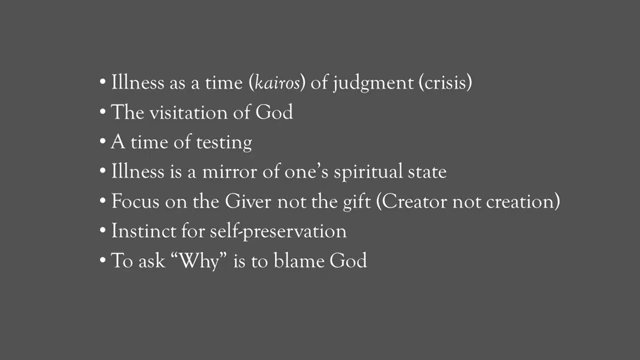
So he describes illness as a time of crisis, but crisis in the rich sense of judgment. The Greek word crisis means judgment; it means you have to make a choice. So the time of crisis is time in that sense of kairos and not chronos, right? Some sort of moment pregnant with possibility and not just the duration of a kind of chronological space. An illness, he says, is the very visitation of God himself, and the moment when we stand before God’s throne as he examines our hearts and reigns, which of course is a quotation from Psalm 7:10. Illness is also a criterion, a standard by which the life and the depth of a person is measured. Illness is like a mirror, he says, in which you can see your spiritual state. And so excessive anxiety about illness reveals a lack or deficiency in one’s spiritual life. When someone is focused solely on his or her illness, which is a gift of God, it’s like he or she is focused on creation and not the creator. It is as if that person’s mind, heart, and strength were directed toward himself and not God. And to be preoccupied with my health, to talk about my aches and pains, to live in fear and anxiety about my health problems, and even to pray to God to make me well can be, he says, and it’s a very strong phrase, it can be a form of idolatry. It’s like a turning away from God to what God has created or allowed to exist. He says illness is natural for us because it can lead us to God. But the instinct for self-preservation, the instinct to survive in this world and in this life, is so worldly and so unnatural that it can lead us away from God. Then he asks the question, why? He says, why do we ask why when sickness comes when we know the answer? God gives us illness so that he can bring us closer to him. So we’re not really asking why to find out why, but because we cannot or will not endure the affliction, so we blame God. The why then is in part a blaming and an accusing of God. It is to place God on trial and put him in the role of defendant.
因此,他将疾病描述为危机的时刻,但这里的危机具有审判的丰富含义。希腊语中的“危机”(crisis)意为审判;意味着你必须做出选择。所以危机的时刻是“契机”(kairos)意义上的时间,而不是“时序”(chronos)意义上的时间,对吧?某种充满可能性的时刻,而不仅仅是时序空间的持续时间。 他说,疾病正是上帝亲自的造访,是我们站在上帝宝座前接受他察验我们心肠肺腑的时刻,这当然是引用了《诗篇》7:10。疾病也是一个准则,一个衡量一个人生命及其深度的标准。他说,疾病就像一面镜子,你可以在其中看到自己的属灵状态。因此,对疾病的过度焦虑表明一个人属灵生活的缺乏或不足。当一个人只关注他或她的疾病——这是上帝的礼物——时,就像他或她只关注受造物而不是创造者。 这就像那个人的心思、意念和力量都指向了自己,而不是上帝。他说,全神贯注于我的健康,谈论我的病痛,生活在对健康问题的恐惧和焦虑中,甚至祈求上帝让我痊愈,这可能——这是一个非常强烈的措辞——这可能是一种偶像崇拜。这就像背离上帝,转向上帝所创造或允许存在的事物。 他说,疾病对我们来说是自然的,因为它能引导我们走向上帝。但是自我保存的本能,在这个世界和今生中生存的本能,是如此世俗和反常,以至于它会使我们远离上帝。然后他提出问题,为什么?他说,既然我们知道答案,为什么当疾病来临时我们还要问为什么?上帝赐予我们疾病,是为了让我们更亲近他。所以我们问为什么并不是真的为了找出原因,而是因为我们不能或不愿忍受苦难,所以我们责怪上帝。 因此,这个“为什么”在某种程度上是对上帝的责备和指控。这是将上帝置于审判之中,让他扮演被告的角色。
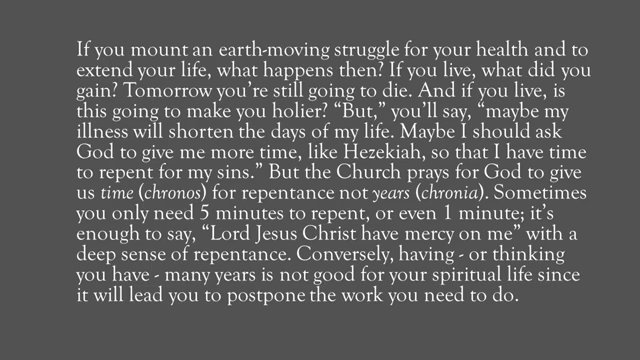
Here I’d like to share with you a very remarkable story that the elder once shared about a monk in the monastery called Father Arsenios. And I like to call the story Thy Will Be Done. Father Arsenios had a problem with his eyes and was told by the doctor that he had cataracts and would need surgery. But not right away, the doctor said. They needed to wait until the condition had progressed a bit further. Father Arsenios waited, but then suddenly lost his eyesight. He went to another doctor for the surgery, but the other doctor told him, unfortunately, it’s too late. You should have come to me sooner. It’s too late now. I can’t do anything for you. You’re going to be blind for the rest of your life because you didn’t have cataracts like the other doctor told you. It was something else. Instead of getting angry, instead of getting depressed, instead of blaming the first doctor, Father Arsenios said, may it be blessed. God knows what is best for me. And it was God who, quote, blinded the first doctor when he made his mistaken diagnosis. And the elder says, until the day he died, he never said one word against the first doctor, nor were his thoughts ever troubled about the matter. And the elder goes on to say that another kind of person can have an accident or mishap or be diagnosed with an illness or have a problem and become angry at God and doubt the very existence of God. This is a very human response, but it is ultimately a denial and a rejection of the will of God. It is a refusal or an inability to accept the reality of divine providence, or of a God who is love as the foundation of life. Rather than look at God, such a person looks only at his health or his cure. And instead of choosing God, he chooses his illness, often at the cost of his own spiritual loss. But, he continues, there are those who accept all things as gifts from God, and they use them in their growth toward perfection in Christ, and thus they are sanctified and become saints. He says, there is no one who cannot become a saint, but we do not become saints because we want to become something else. Then he says, we light the flame of faith, but we don’t want to be burned. That is, we don’t want to deny ourselves. We do not want God, but we choose ourselves instead. And then my last quotation from the elder, he says, if you mount an earth-moving struggle for your health and to extend your life, what happens then? If you live, what did you gain? Tomorrow, you’re still going to die. And if you live, is this going to make you holier? But you’ll say, maybe my illness will shorten the days of my life. Maybe I should ask God to give me more time, like Hezekiah, so that I have time to repent for my sins. But the church prays for God to give us time for repentance, not years. Sometimes you only need five minutes to repent, or even one minute. It’s enough to say, Lord Jesus Christ, have mercy on me, with a deep sense of repentance. Conversely, having or thinking you have many years is not necessarily good for your spiritual life, because it will lead you to postpone the work that you need to do.
在这里,我想与大家分享一个长老曾经分享过的非常非凡的故事,关于修院里一位名叫阿塞尼奥斯神父的修士。我喜欢把这个故事称为“愿你的旨意成就”。 阿塞尼奥斯神父的眼睛有问题,医生告诉他他患有白内障,需要做手术。但医生说,不是马上做。他们需要等到病情进一步发展。 阿塞尼奥斯神父等待着,但随后突然失去了视力。 他去找另一位医生做手术,但另一位医生告诉他,很遗憾,太晚了。 你应该早点来找我。现在太晚了。我无能为力。你余生都要失明了,因为你并没有像另一位医生告诉你的那样患有白内障。那是别的病。 阿塞尼奥斯神父没有生气,没有沮丧,也没有责怪第一位医生,而是说:“愿这成为祝福。” 上帝知道什么对我最好。引用他的话说,是上帝在第一位医生做出错误诊断时蒙蔽了他。长老说,直到他去世的那一天,他从未说过一句反对第一位医生的话,他的心思也从未因这件事而烦恼。长老接着说,另一种人可能会遭遇意外或不幸,或者被诊断出患有疾病,或遇到问题,从而对上帝发怒,甚至怀疑上帝的存在。 这是一种非常人性的反应,但归根结底,这是对上帝的旨意的否认和拒绝。这是拒绝或无法接受神意的现实,或者无法接受以作为爱的上帝为生命的基础。这样的人不看上帝,只看自己的健康或治愈。 他没有选择上帝,而是选择了他的疾病,这往往以他自己的属灵损失为代价。 但是,他继续说道,有些人将一切事物视为来自上帝的礼物而接受,并在他们向着在基督里的完美成长的过程中使用它们,从而他们被圣化并成为圣人。 他说,没有人不能成为圣人,但我们没有成为圣人,是因为我们想成为别的什么。 然后他说,我们点燃了信仰的火焰,却不想被燃烧。也就是说,我们不想否定自己。我们不要上帝,而是选择了我们自己。然后是我引用长老的最后一句话,他说,如果你为了你的健康和延长你的生命而展开一场惊天动地的斗争,那会怎样呢? 如果你活下来了,你得到了什么?明天,你依然会死。如果你活下来了,这会让你更圣洁吗? 但你会说,也许我的疾病会缩短我生命中的日子。也许我应该求上帝给我更多时间,就像希西家一样,好让我有时间为我的罪悔改。 但教会祈求上帝给我们悔改的时间,而不是几年。 有时你只需要五分钟来悔改,甚至一分钟。带着深深的悔改之情说“主耶稣基督,请怜悯我”就足够了。相反,拥有或认为自己有很多年,对你的属灵生活未必是好事,因为这会导致你推迟你需要做的工作。
Conclusion. Illness is one of the ways that God works on us. Similar to the way one kneads a lump of dough, or carves a piece of wood, or chisels a piece of stone into an image of Christ, God takes hold of us through illness, and he works on our soul, refashioning it and reforming it. We often think that God will come into our life by means of some pleasant experience that will require little or no change on our part. However, God is more likely to enter our lives through a crisis, like a serious illness or some other affliction. For these are the signs, not of God’s absence, but of his active presence. As we see in the Elder’s commentary on the Book of Psalms, God comes to us in the dark cloud. God comes to us in the eye of the storm, in the midst of our difficulties, in the midst of our pain, and in the midst of our suffering. God is at once the source of affliction and the gentle healer. And this seems to be because affliction alone can tear us away from our isolated individual existence and transform us into something much more whole and much more open. The self-consoling dreams and delusions of the ego make it hard for us to perceive the reality of God. But when all the illusions are swept away by some affliction, it is then that I begin to call and cry out to God, like the psalmist who said, quote, “In my affliction, I cried out to the Lord and he heard me,” Psalm 18.5. And so the crisis that engulfs me, the pain that I feel is a kind of birth pang, for it is the initial movement of my soul longing to be united to God. And my longing for God is met by God’s longing for me. For it is God who is seeking me in and through my sufferings, in and through my pain, so that in the end, a spiritual crisis is not the agony of man struggling to find God, but the agony of God struggling to find man. Thank you.
结论。疾病是上帝在我们身上动工的方式之一。就像人揉捏一团面团,雕刻一块木头,或将一块石头凿刻成基督的圣像一样,上帝通过疾病抓住我们,在我们的灵魂上动工,重塑它,改造它。我们常常认为,上帝会通过某种愉快的经历进入我们的生命,而这种经历几乎不需要我们做出任何改变。然而,上帝更有可能通过一场危机进入我们的生命,比如一场重病或其他某种苦难。因为这些不是上帝缺席的标志,而是他积极同在的标志。正如我们在长老对《诗篇》的注释中所看到的,上帝在乌云中向我们走来。上帝在风暴的中心向我们走来,在我们的困境中,在我们的痛苦中,在我们的受苦中向我们走来。上帝既是苦难的源头,也是温柔的医治者。这似乎是因为只有苦难才能将我们从孤立的个体存在中撕裂开来,并将我们转变为更加完整、更加开放的存在。自我安慰的梦境和自我的妄想使我们很难感知上帝的真实。但是当所有的幻象都被某种苦难一扫而空时,正是在那时,我开始呼求并向上帝呼喊,就像那位诗人所说,引文:“我在苦难中呼求主,他就应允了我”,诗篇18.5。因此,吞噬我的危机,我所感受到的痛苦,是一种产痛,因为这是我渴望与上帝合一的灵魂的最初悸动。而我对上帝的渴望,遇到了上帝对我的渴望。因为正是上帝在我的受苦中,在我的痛苦中寻找我,所以归根结底,属灵的危机不是人挣扎着寻找上帝的痛苦,而是上帝挣扎着寻找人的痛苦。谢谢。